Divination has long formed part of folk traditions throughout Europe and America, and Appalachia was no exception.
People looked for meaning in dreams, weather, animals, household accidents and unusual events.
Playing cards could be used for fortune-telling.
Tea leaves might be examined.
Dreams could be interpreted.
Signs in nature might be regarded as warnings or indications of what was coming.
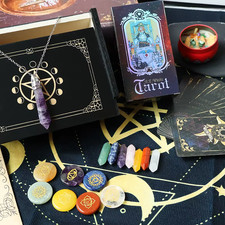
Modern Tarot cards can comfortably sit beside these older methods, although Tarot should not automatically be presented as an ancient Appalachian tradition.
For the solitary Pagan Witch, folk-style divination has one enormous advantage:
it requires very little equipment.
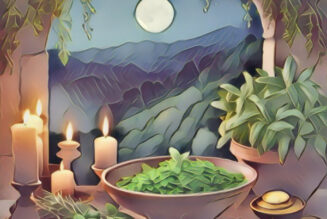
Consider water scrying.
Place a bowl of water before you in a quiet room.
Allow the surface to become completely still.
Rather than forcing yourself to see supernatural visions, simply relax and observe.
Notice reflections.
Notice shapes.
Notice what thoughts enter your mind.
The exercise can become a form of meditation and intuitive reflection.
Cloud divination can be approached similarly.
Sit outdoors and watch clouds slowly change shape.
What images do you notice?
What associations immediately come to mind?
The purpose need not be predicting the future with certainty. Divination can instead help reveal thoughts and feelings already sitting beneath conscious awareness.
Dreams were also important within traditional folklore.
A solitary Witch might therefore keep a dream journal beside the bed.
Write down whatever you remember immediately after waking.
After several months, patterns may become apparent.
Certain places might repeatedly appear.
Certain animals may return.
Perhaps the same person appears whenever you are worried about something.
These patterns can become part of your personal magical language.
Animals provide another traditional source of signs.
Crows, owls, spiders, snakes and other creatures have accumulated enormous bodies of folklore.
But there is an important difference between appreciating symbolism and assuming that every animal encounter is a supernatural message.
Sometimes a crow is simply looking for food.
Sometimes a spider has built its web in a convenient place.
A grounded Pagan practice leaves room for both possibilities.
You can ask:
“Regardless of why this happened, what does this encounter mean to me?”
That question can be far more useful than trying to prove that a deity or spirit deliberately sent the animal.
Spiders provide a particularly good example.
A web can symbolise patience, creativity, interconnectedness and the consequences of our actions.
Rather than taking a tradition belonging to another culture, a solitary Witch can develop their own meditation around the spider.
Sit quietly near a web without disturbing it.
Observe its structure.
Consider how every strand connects with another.
Ask yourself:
What am I weaving into my own life?
That is folk magic at its simplest.
The natural world becomes both teacher and mirror.
You observe what surrounds you and allow those observations to encourage reflection.
No priesthood is required.
No initiation is necessary.
You simply learn to notice.