The word “Airt” comes from old Gaelic and refers to the four main directions: north, south, east, and west. These directions have been important in magical traditions for centuries, forming the basis for rituals and spiritual practices.
In magic, the ritual circle is usually aligned with the Four Airts. This is done because each direction is believed to bring its own unique energy and elemental influence, which can affect the outcome of magical work.
The idea of aligning with the cardinal points is not limited to witchcraft. For example, early Christian churches were often built with the altar facing east, symbolizing new beginnings and the rising sun. Even when this was not possible, the tradition highlights the lasting respect for direction in sacred spaces.
Ancient monuments like the Great Pyramid of Giza also show careful alignment with the cardinal points, suggesting that many cultures have recognized the power of these directions.
In a magical circle, it is common to place a candle or lamp at each of the four quarters. This marks the presence of the Airts and invites the energy of each direction into the ritual.
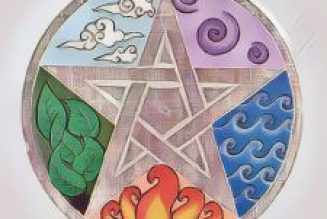
The Four Elements—air, fire, water, and earth—are closely linked to the Airts. In Western traditions, air is usually connected to the east, fire to the south, water to the west, and earth to the north.
These connections are based on the qualities of the winds and natural events. For example, in Britain, the south wind is warm and dry, so it is linked to fire. The west wind brings rain, so it is connected to water.
The east wind is cold and clear, representing air, which stands for clarity, intellect, and new beginnings. The north wind is cold and harsh, linked to earth, which symbolizes stability, endurance, and the mysteries of darkness.
These associations can change in other places, depending on local climate and tradition. Practitioners often observe their own environment and adjust the elemental connections to fit the energies of their land.
The Four Airts are also linked to certain colors: east with the red of dawn, south with the white of noon, west with the grey of twilight, and north with the black of midnight. These colors are often used in ritual tools, altar decorations, and visualizations to strengthen the connection to each direction.
Old texts and folklore show the lasting influence of the Airts. For example, the song “Black Spirits,” which appears in Shakespeare’s Macbeth but comes from Middleton’s play The Witch, may have even older roots. The chant calls on spirits from the four directions, using their colors and energies:
“Black spirits and white, Red spirits and grey, Mingle, mingle, mingle, You that mingle may! Firedrake, Pucky, make it lucky. Liard, Robin, you must bob in, Round, around, around about, about! All ill come running in, all good keep out!”
In this chant, the spirits and their colors match the Airts, and the names Firedrake, Pucky, Liard, and Robin are magical helpers or familiars.
Today, witches might use a simpler version of this chant, such as: “Black spirits and white, Red spirits and grey, Come ye and come ye, Come ye that may! Around and around, Throughout and about, The good come in And the ill keep out.” These words are used to invite the protective and transformative powers of the Four Airts during rituals.
Practices related to the Airts go beyond chants and colors. Moving around the circle, called circumambulation, is done either deiseil (clockwise, or sunwise) for blessings and positive magic, or tuathal (counterclockwise, or widdershins) for banishing or cursing. In Celtic tradition, deiseil is considered lucky, while tuathal is used for more serious or negative work.
The names for the directions come from Scots Gaelic: tuath for north, airt for east, deas for south, and iar for west. Rituals often start in the east, the place of new beginnings, and move deiseil to follow the sun’s path, calling on each element and its qualities in turn.
In the past, people called on the Airts for protection, guidance, and balance. Travelers might carry charms for each direction, and farmers might walk sunwise around their fields to bless them, asking the elements for fertility and safety.
In modern witchcraft, the Four Airts are still important for rituals and meditation. Practitioners may set up altars for each direction and element, or use colored candles and stones to represent the Airts in their spells. Meditations often include visualizing the energy of each direction, drawing strength and protection from the elemental guardians.
The Four Airts help remind us of our connection to nature and the cycles that shape both magic and life. By honoring the directions and their elements, practitioners can align themselves with the rhythms of the earth, finding harmony, insight, and empowerment on their spiritual path.