Throughout history, the figure of Krampus has served as a cautionary symbol, intended to encourage children to behave well during the holiday season. Unlike the cheerful and generous St. Nicholas, Krampus is a creature of warning—a reminder that actions have consequences, and that not all winter tales are filled with light and joy.
When tuning in to festive radio stations in December, one is unlikely to encounter carols celebrating Krampus. This half-goat, half-demon entity is a stark contrast to the warmth and merriment typically associated with the holidays. With his fearsome appearance and menacing reputation, Krampus is said to punish those who have misbehaved, literally beating them into good behavior and ensuring that the line between naughty and nice is clearly drawn.
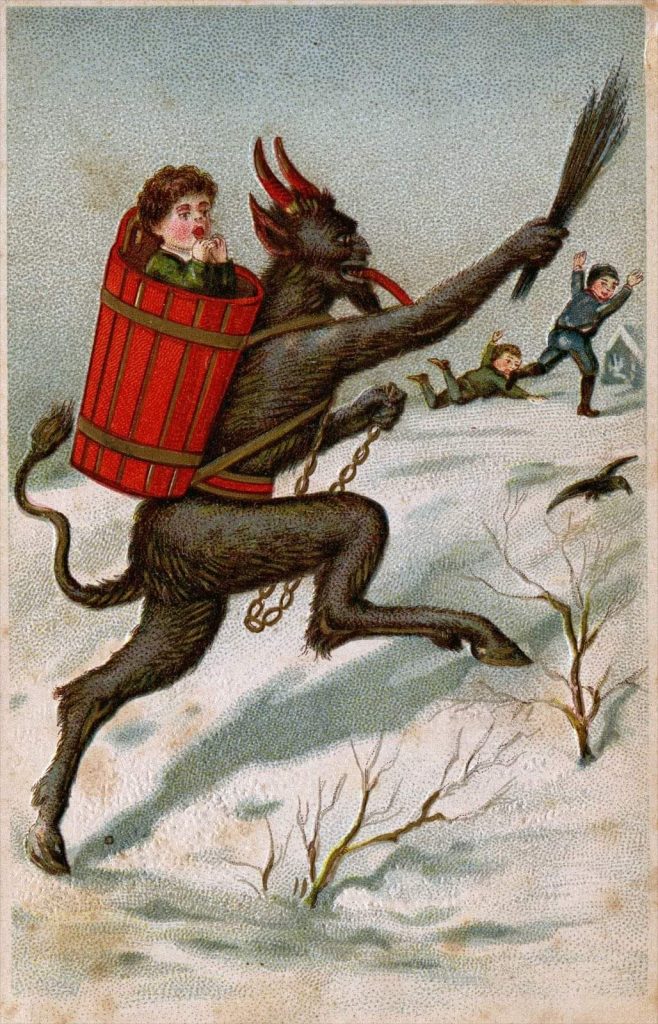
The image of Krampus is striking and memorable. He is often depicted with large, curling horns, shaggy dark hair, sharp fangs, and an unnaturally long tongue. Chains and bells hang from his body, clanking ominously as he moves. In one hand, he wields a bundle of birch sticks, known as a “ruten,” which he uses to swat misbehaving children. In some versions of the legend, Krampus even carries a sack or basket on his back, in which he places the worst offenders before dragging them away to the underworld. This vivid imagery has helped the legend persist for generations.
The tradition of Krampus is closely tied to that of St. Nicholas, the patron saint of children, whose feast day falls in early December. In many European cultures, St. Nicholas is celebrated as a figure of kindness and generosity, rewarding well-behaved children with gifts and sweets. However, the holiday season also brings with it the threat of punishment for those who have not met expectations. In regions such as Germany and Austria, Krampus is the most feared of these punitive figures, but he is not alone. Other Germanic traditions include Belsnickel and Knecht Ruprecht, both of whom are depicted as stern, black-bearded men who carry switches to discipline children. In France, similar roles are filled by Hans Trapp and Père Fouettard, who accompany St. Nicholas and serve as reminders of the consequences of misbehavior.
The name “Krampus” is derived from the German word “krampen,” meaning “claw,” which is fitting given his fearsome appearance. Some legends even claim that Krampus is the son of Hel, the Norse goddess of the underworld, further cementing his association with darkness and punishment. Additionally, Krampus shares characteristics with mythological creatures from Greek tradition, such as satyrs and fauns, who are also depicted as part-human, part-animal beings with mischievous or sinister tendencies.
The origins of the Krampus legend can be traced back to centuries-old Christmas traditions in the Alpine regions of Europe, particularly in Germany and Austria. Here, the holiday season begins in early December, and the arrival of St. Nicholas is eagerly anticipated by children. While St. Nicholas rewards the virtuous, Krampus serves as his dark counterpart, punishing those who have strayed from the path of good behavior. According to folklore, Krampus would swat “wicked” children, stuff them into his sack, and carry them off to his lair—a fate that inspired both fear and obedience.
One of the most notable events associated with Krampus is Krampusnacht, or Krampus Night, which takes place on the evening of December 5th. On this night, it is said that Krampus roams the streets, searching for children who have misbehaved. The following day, December 6th, is Nikolaustag, or St. Nicholas Day. On this morning, children eagerly check the shoes or boots they left outside their doors the night before. Those who have been good find them filled with gifts and treats, while those who have not may discover a rod or switch—a clear sign that Krampus has paid them a visit.
In modern times, the tradition of Krampus has evolved and taken on new forms in various countries, including Austria, Germany, Hungary, Slovenia, and the Czech Republic. One popular event is the Krampuslauf, or Krampus Run, during which participants dress as Krampus and parade through the streets, often chasing onlookers and playfully frightening children and adults alike. These events are lively and theatrical, blending ancient folklore with contemporary celebration. In some towns, the Krampuslauf has become a major annual attraction, drawing visitors from around the world.
The resurgence of Krampus in recent years can be attributed in part to a growing interest in alternative and non-traditional ways of celebrating the holiday season. In the United States and other countries, Krampus has become a symbol of the “dark side” of Christmas, inspiring movies, television episodes, themed parties, and even Krampus-themed races. This renewed fascination reflects a desire to explore the full spectrum of holiday traditions, from the joyful to the macabre.
As Krampus gains popularity, some regions have sought to commercialize his image. In Austria, for example, one can find Krampus-themed chocolates, figurines, and collectible horns for sale during the holiday season. While these products help keep the tradition alive, there are concerns that commercialization may dilute the original meaning and impact of the legend. Some critics argue that as Krampus becomes more mainstream, he risks losing the edge that once made him a truly fearsome figure.
Ultimately, the story of Krampus serves as a fascinating reminder of the complexity and diversity of holiday traditions. Whether viewed as a symbol of discipline, a figure of folklore, or a source of festive entertainment, Krampus continues to captivate the imagination and add a unique dimension to the winter season.