For the solitary Pagan witch, freedom can be one of the most important parts of the path. There is no coven deciding what you must believe, no high priest or priestess whose word must be accepted, and no religious authority handing you a list of approved practices.
Yet that does not mean we are completely free from religious influence.
Many of the ideas surrounding Witchcraft today have developed within cultures heavily influenced by organised religion. Ideas about good and evil, acceptable and forbidden magic, spiritual authority, sin, purity and even what a witch is supposed to believe can have surprisingly deep roots.
For the solitary witch, understanding those influences is important because it allows us to ask a simple question:
Do I genuinely believe this, or have I simply inherited somebody else’s rules?
The Poisoned Chalice: Religious Control
Religious control occurs when religious beliefs or institutions attempt to define what people may believe, practise or experience spiritually.
Historically, this could be extremely direct.
As Christianity became dominant across Europe, older religious and magical customs were variously condemned, adapted, absorbed or reinterpreted. Some practices survived within folk traditions, sometimes existing alongside Christian beliefs rather than completely disappearing.
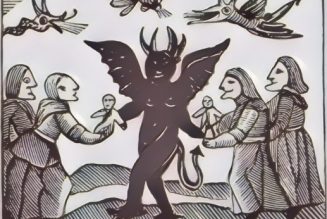
The European witch trials, particularly between the fifteenth and eighteenth centuries, created an especially powerful image of Witchcraft as dangerous and diabolical. Thousands of people were executed following witchcraft prosecutions, although the people accused were not necessarily practising “witches” in the modern Pagan sense.
Books such as the Malleus Maleficarum, first published in 1486–87, helped promote frightening ideas about witches, demons and supposed pacts with the Devil.
Those ideas left a cultural shadow that survived long after the trials themselves ended.
Even today, Witchcraft is sometimes automatically associated with evil, Satanism or dangerous supernatural forces.
But there is another, quieter form of control that can be harder to recognise.
It happens when people carry old religious assumptions into a new spiritual path without questioning them.
Leaving One Rulebook for Another
Modern Witchcraft and Paganism have developed enormously since the twentieth century. Traditions such as Wicca helped bring Witchcraft into public awareness and provided structured systems for people wanting to practise it.
But a solitary Pagan witch does not automatically have to inherit those systems.
You do not necessarily need degrees, initiations, covens, priesthoods or established traditions to explore Witchcraft.
Nor must you automatically accept ideas such as karma, the Threefold Law, “harm none,” divine punishment or the belief that every magical action will somehow return to you.
Those ideas may be deeply meaningful to some practitioners.
The important thing is recognising that they are beliefs rather than universal laws of Witchcraft.
A solitary witch is free to examine them and decide whether they belong on their path.
Otherwise, we risk walking away from one religious structure only to recreate another.
Who Decides What Is “Good” Witchcraft?
One lingering influence of religious thinking is the desire to divide spiritual practices neatly into good and evil.
We sometimes see this expressed through labels such as “white magic” and “black magic,” or through claims that a “real witch” would never curse, hex, practise defensive magic or work with uncomfortable aspects of life.
A solitary witch can question those boundaries.
That does not mean abandoning personal responsibility. Quite the opposite.
Freedom requires responsibility.
Instead of following somebody else’s commandments, the solitary practitioner develops their own ethical boundaries and accepts responsibility for their choices.
You might decide never to curse.
Another witch might believe defensive or retaliatory magic is acceptable under certain circumstances.
Neither decision needs to come from a spiritual authority standing above you.
Your ethics should be something you have considered, not merely something you have inherited.
Beware the New Spiritual Authorities
Religious control does not always arrive wearing robes and carrying a holy book.
Sometimes it arrives through books, social media, courses, organisations and people claiming to know the “correct” way of being Pagan.
You may encounter people insisting that every Pagan must worship gods and goddesses, celebrate particular festivals, construct an altar in a certain way or accept particular spiritual laws.
The solitary Pagan witch has the luxury of asking:
Why?
Who created that rule?
How old is it?
Which tradition does it belong to?
And, most importantly:
Why should it apply to me?
Tradition can be valuable. Books can be valuable. Teachers can be valuable.
But learning from something does not require surrendering your independence to it.
Reclaiming the Solitary Path
Perhaps one of the greatest strengths of solitary Witchcraft is the ability to question.
Your Witchcraft might involve candles, herbs, divination, spirits, ancestors, meditation, spellcraft, nature or seasonal observances.
Or it might look completely different.
You may believe in many gods, one divine presence, spirits, nature itself—or no gods whatsoever.
The solitary path gives you room to explore.
This does not mean pretending history does not matter. Understanding where our practices and beliefs came from can actually make us more independent because we begin recognising the difference between ancient tradition, modern reconstruction and somebody’s personal opinion.
The solitary Pagan witch does not need another church.
There does not have to be another priesthood, another collection of commandments or another group of people deciding who is spiritually acceptable.
Study the old ways. Explore modern traditions. Listen to experienced practitioners. Read widely and question everything—including your own assumptions.
Keep what genuinely speaks to you.
Question what does not.
And never be afraid to say:
“That may be your Witchcraft, but it doesn’t have to be mine.”